
Call Today for a FREE Consultation
210-342-3400
The Option of Severing Your Chapter 13 Case from Your Spouse
 When you file Chapter 13 bankruptcy jointly with your spouse, you commit to a repayment plan that typically lasts three to five years. During that time, life can change dramatically. One of the most significant changes that can happen is divorce or separation. If you and your spouse decide to end your marriage while you are still in an active Chapter 13 case, you might wonder what happens to your bankruptcy.
The good news is that Texas bankruptcy law provides options in 2026 for married couples who file jointly but later separate. You can sever your joint Chapter 13 case into two separate individual cases, dismiss the case entirely, or convert it to Chapter 7 bankruptcy. Our New Braunfels bankruptcy attorney can explain how.
What Happens to a Joint Chapter 13 Case When You Get Divorced?
A Chapter 13 case requires cooperation between spouses who file jointly. You create a single repayment plan based on your combined household income and expenses. You make one monthly payment to the bankruptcy trustee, who then distributes the money to your creditors according to the approved plan.
Divorce changes everything about this arrangement. Your household income splits into two separate incomes. Your expenses change as you establish separate households. The financial goals that made sense when you were married may no longer work for either person on their own. The family home you were trying to save through Chapter 13 might now need to be sold as part of the divorce settlement.
Under Section 1307 of the United States Bankruptcy Code, you have the right to modify your Chapter 13 case when circumstances change substantially. Divorce certainly qualifies as a substantial change in circumstances. This gives you legal grounds to ask for changes to your bankruptcy case that match where you are now.
Can You Sever a Joint Chapter 13 Case Into Two Separate Cases?
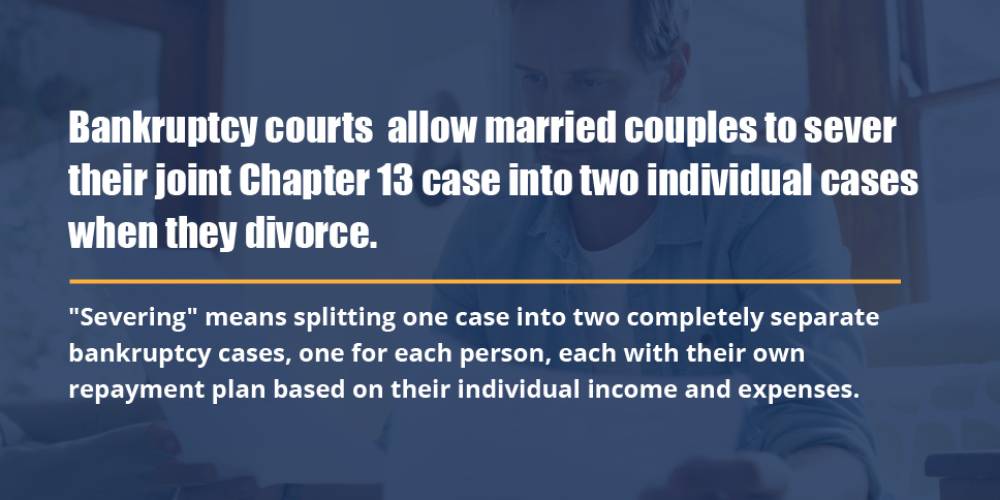
Bankruptcy courts regularly allow married couples to sever their joint Chapter 13 case into two individual cases when they separate or divorce. Severing means splitting one case into two completely separate bankruptcy cases, one for each person. Each person then has their own case with their own repayment plan based on their individual income and expenses.
Your bankruptcy attorney files a motion with the court requesting that the joint case be severed. The motion explains that you and your spouse are separating or divorcing and need your own cases. Bankruptcy judges understand that couples who are ending their marriage cannot realistically continue working together on a joint repayment plan. They almost always grant these severance requests.
What Happens After Your Bankruptcy Case Is Severed?
Once the court severs your joint case, each person must file an amended Chapter 13 plan for their individual case. Your new plan reflects only your income, your expenses, and your share of the debts. The bankruptcy trustee will review each amended plan to make sure it meets legal requirements and treats creditors fairly.
After severance, you and your ex-spouse work independently in the bankruptcy system. One person's decisions about their case do not affect the other person's case. This independence is important because your financial situations may be very different after divorce. One spouse might have a higher income and be able to pay more to creditors, while the other might struggle to make even reduced payments.
Should You Dismiss Your Chapter 13 Case Instead of Severing It?
Dismissing your Chapter 13 case means ending the bankruptcy without completing the repayment plan. You can almost always voluntarily dismiss a Chapter 13 case if you decide it no longer serves your needs. Bankruptcy law allows this flexibility because lawmakers want people to have the option to exit if circumstances change.
Dismissal might make sense if neither you nor your spouse benefits from staying in Chapter 13 after the divorce. Perhaps the main reason you filed was to save the family home, but now you are selling it as part of the divorce settlement. Or maybe your combined income made the Chapter 13 payments manageable, but separately neither of you can afford to continue.
If you dismiss your joint Chapter 13 case, both of you are free to decide what comes next. You can each file a new individual Chapter 13 case with terms that work for your separate situations. You can file Chapter 7 bankruptcy instead. Or you can choose not to file bankruptcy at all if your financial situation has improved or you have other ways to handle your debts.
Is Converting to Chapter 7 Bankruptcy a Better Option?
You also have the option to convert your joint Chapter 13 case into a joint Chapter 7 case. Chapter 7 bankruptcy moves much faster than Chapter 13, typically finishing within three to four months. Instead of making payments over several years, Chapter 7 liquidates any non-exempt assets to pay creditors and then discharges most remaining debts.
Converting to Chapter 7 might work well if the reasons you originally chose Chapter 13 no longer apply after your separation. For example, you may have filed Chapter 13 to catch up on mortgage payments and save the family home. If you are now selling the house as part of the divorce, there is no reason to continue the long Chapter 13 repayment plan. Chapter 7 can eliminate your other debts quickly and let you move on with your separate lives.
After converting to Chapter 7, the trustee will sell the non-exempt assets and distribute the money to creditors according to bankruptcy priority rules. Both spouses still participate in the joint Chapter 7 case through completion. Once the case is closed and you receive your discharge, you are both free from the discharged debts.
Call a New Braunfels, TX Bankruptcy Attorney Today
With over 20 years of experience, our Boerne, TX bankruptcy lawyer with the Law Offices of Chance M. McGhee can help you understand your options and choose the path that protects you. Whether you need to sever your case, dismiss it, or convert to Chapter 7, we can help.
Our firm offers free consultations. Discuss your situation and learn how bankruptcy law applies to your divorce by calling the Law Offices of Chance M. McGhee at 210-342-3400 today.
Call Today for a FREE Consultation
210-342-3400